

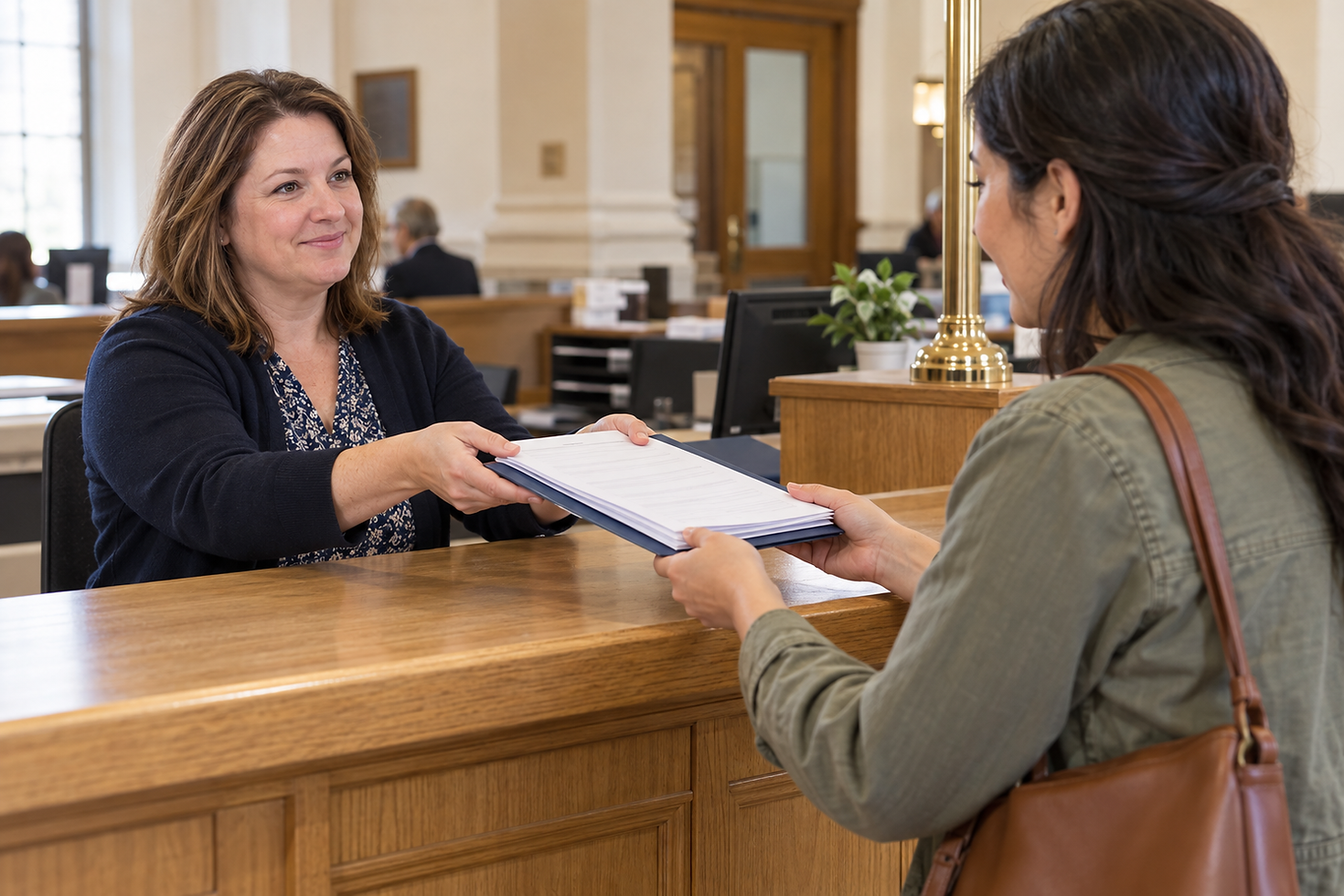
At the Clerk’s Counter: A Practical Guide to Court Paperwork

Court paperwork can feel harder than the problem that brought you there. You may know what happened but still be unsure which form to use, where to file it, or what happens after you hand it over.
The clerk’s office and court self-help services can make that process more manageable. This guide focuses on the practical work of preparing, filing, and tracking documents. It uses U.S. state-court examples. Fees, deadlines, and available help differ by court and case type; the examples below are not nationwide rules.
1. Find the court clerk who handles your case
If you received court papers, begin with the court name, case number, and division printed on them. For a new case, use the official court’s website and self-help resources to identify the appropriate court and location. A county clerk who handles elections or recording deeds may not handle court filings. Look specifically for the court clerk, clerk of superior or circuit court, or the relevant justice or municipal court.
Confirm the filing location and available methods before traveling. For example, Yavapai County, Arizona, accepts Superior Court filings online, by mail, and in person, with specific instructions for each method. Its clerk also explains that staff cannot provide legal advice. [1]
2. Ask for procedural help and forms assistance
A useful opening is: “I am representing myself in this case. Where can I find the current forms, local filing instructions, fee schedule, and self-help services?” Have your case number ready and explain the task briefly.
Is there a complete packet, including instructions and required local forms?
Does the court offer appointments, workshops, guided online forms, or a forms review?
How many copies are needed, and are electronic filings available to self-represented people?
Where are the rules on service, deadlines, confidential documents, and filing fees?
How do I request an interpreter or disability accommodation?
Clerks can direct you to procedures and resources. They cannot act as your lawyer or decide which legal argument you should make. A self-help center or law library may offer more detailed forms assistance, depending on the service. Ask what it covers and whether your conversation is confidential. [1, 2]
3. Use the current packet and complete every required part
Download forms from the official court or its linked self-help service. Read the instructions before writing. Check whether you need a cover sheet, summons, financial declaration, supporting declaration, proposed order, or separate confidential information form. A packet for starting a case may be different from one for responding.
Check the caption at the top: court name, parties, case number, and department when required. In an existing case, preserve the party designations rather than swapping plaintiff and defendant because you are now filing a request. Complete required sections accurately and sign everywhere your signature is required. Follow the instructions for blanks, attachments, sworn statements, electronic signatures, and notarization. Do not sign a judge’s or clerk’s signature line. [2]
Make a final pass for missing pages, inconsistent names, unreadable scans, and attachments that the form refers to but does not include. Check local formatting rules, including paper size, one-sided copies, margins, page limits, and PDF requirements. Ask a self-help service about unclear questions before submitting your answer.
Review privacy rules before attaching bank statements or other sensitive records. For example, California Rule 1.201 generally requires Social Security and financial account numbers in public filings to be omitted or limited to the last four digits, subject to exceptions. Follow your own court’s rules for redaction and confidential forms. Do not assume the clerk will remove sensitive information for you. [3]
4. Check the full cost before filing
There is no single “court filing fee.” Starting a case, filing an answer, obtaining certified copies, and arranging service can involve different charges. Some filings have no fee. Ask about payment methods, electronic service-provider charges, and whether a waiver covers each cost.
These published examples, checked October 10, 2026, show the range of costs you may encounter. Confirm the current amount for your exact filing before paying:
Yavapai County, Arizona, Justice Courts: civil complaint $86; answer to a civil complaint $47; answer to a small claims complaint $18; ordinary document copies $0.50 per page. These are Justice Court fees, not Superior Court fees. [4]
California small claims: $30 for a claim up to $1,500; $50 for a claim over $1,500 and up to $5,000; $75 for a claim over $5,000 and up to $12,500. The fee is $100 if you filed more than 12 small claims cases in the preceding 12 months. Separate rules determine how much you may claim. [5]
California divorce response: the court’s guide lists a filing fee of $435–$450. [6]
Sacramento County, California: the public law library describes sheriff service fees of $50 per address/person for most documents. Confirm the sheriff’s current fee and waiver requirements; private process-server prices vary. [7]
5. Ask about a fee waiver or deferral early
If paying court fees would prevent you from meeting essential needs, ask for the court’s application and instructions before you file. A waiver removes covered fees, subject to the order and applicable rules. A deferral postpones payment or allows payments over time; it is not necessarily forgiveness of the debt. [8]
Gather the financial information the application requests, such as income, household size, essential expenses, assets, and benefit documentation. Give complete, truthful answers. Eligibility may depend on benefits, income, or inability to meet basic needs while paying fees. Rules and proof requirements differ.
Arizona example: the application is AOCDFGF1F. The state distinguishes SSI-based waiver eligibility from TANF or food-assistance-based deferral eligibility, with supporting proof. Service costs may require a separate affidavit. Deferred fees can remain collectible, and the process may require a supplemental application at the end of the case. Read both the application and the resulting order. [8, 9]
California example: Orange County’s instructions say to read FW-001-INFO, complete FW-001 and the applicant sections of FW-003, and file them with your other papers. The court may request more information or a hearing. Its guidance warns that a denied request requires action within 10 days from mailing of the order. Follow the deadline and options in your own order immediately. [10]
A filing-fee waiver does not appoint a lawyer. It also does not automatically cover every private expense, fine, sanction, or other obligation. Ask which costs are covered, what must be separately requested, and whether later repayment or financial updates may be required. [8, 10]
6. File and keep proof of what the court accepted
Keep an exact copy of the packet you submit. For paper filing, bring the number of copies the court requires. Yavapai County’s Superior Court instructions call for the original plus two copies; mailed submissions need a self-addressed stamped envelope for returned copies. Your court may use a different process. [1]
For electronic filing, save your submitted PDFs, transaction receipt, and acceptance or rejection notice. Confirm how your court assigns the filing date and handles rejected submissions. An upload confirmation alone should not be treated as proof that the court accepted everything. If a document is rejected, address the stated reason promptly and get advice about any affected deadline.
Ask how you will receive orders and hearing notices, whether you must request a hearing separately, and how to update your address or email. Keep a folder containing filed copies, receipts, orders, and service records.
7. Complete service and file the required proof
Filing places papers in the court record. Service formally gives required notice to another party. These are separate tasks. Learn which documents must be served, on whom, by what method, and by what deadline.
Do not assume ordinary email or handing over papers yourself is sufficient. Initial summons service and later document service may follow different rules. California’s service guidance generally requires a nonparty adult to perform service; other jurisdictions may require certified servers or court officials. Use the rules for your court and document type. Have the server complete the appropriate proof of service and make sure it is filed when required. [7]
8. Build your calendar from the actual rules
Write down the event that starts each deadline, the number and type of days, the resulting due date, and the source of the rule or order. Confirm how weekends, holidays, service methods, and filing cutoffs affect the calculation. Keep hearing dates separate from response and service deadlines.
Concrete example: California’s divorce guide generally requires a response within 30 days of service. That does not create a 30-day rule for other cases. Eviction, protective-order, criminal, appeal, and other proceedings can follow very different schedules. [6]
There is no reliable nationwide turnaround time for forms review, clerk processing, fee-waiver decisions, or hearing dates. Ask the relevant office about its current process and plan time for corrections. Do not assume that seeking help, applying for a waiver, or waiting for a reply extends a deadline. If time is short, contact a qualified attorney or court self-help service promptly about the available procedure.
9. Request appointed counsel through the correct process
If you face criminal charges and cannot afford an attorney, ask the court how to request appointed counsel as early as possible. Eligibility depends on the proceeding, applicable right to counsel, and financial assessment. The lawyer may be a public defender or another appointed attorney.
State the request clearly: “I cannot afford to hire an attorney. I want to apply for court-appointed counsel. What form and supporting documents do I need?” Follow through with the financial application and keep a copy. Confirm whether counsel has been appointed, how to contact them, and any order about costs.
For example, the Texas Indigent Defense Commission directs applicants to the county’s indigent defense coordinator, court coordinator, or judge. Its guidance describes financial forms, interviews, supporting documents, and possible ability-to-pay assessments. Follow your own jurisdiction’s process rather than assuming a national income cutoff or that every appointment is entirely cost-free. [11]
For most ordinary civil disputes, a public defender is not the route to legal representation. Some civil proceedings do provide appointed counsel under specific laws. Ask about that possibility, and also check civil legal aid, pro bono clinics, and limited-scope attorney help. The Legal Services Corporation offers a location-based directory of civil legal aid providers. Eligibility and availability vary. [12, 13]
A final check before you leave or log off
Have I used the correct court, case number, current forms, and required local attachments?
Have I completed signatures, privacy requirements, and the payment or waiver request?
Do I have filed copies or an acceptance notice and a way to check the case?
Who must be served, how will service happen, and who will file proof?
What are the next deadline and hearing date, and where did I verify them?
If I requested counsel, do I know the application’s status and the next step?
You do not need to know every court procedure before asking for help. Arrive with your papers, ask specific questions, take notes, and follow the written instructions. Careful paperwork can make the process more manageable while you decide where professional legal help is needed.
General educational information for U.S. readers, not legal advice. Court requirements and fees change. Confirm the current rules with the court handling your case. Criminal charges and matters involving liberty, safety, housing, or parental rights warrant prompt advice from a qualified attorney.



Comments